



by imran
Top Web Design Trends for 2026: What Every Business Website Needs Now
Web design doesn’t stand still, and neither do your customers’ expectations. What felt fresh and modern in 2023 can look dated by 2026 — and an outdated website quietly costs you conversions, credibility, and search rankings every single day it stays online.
At SheenSol Technologies, we redesign and build websites for businesses across industries, and this year we’re seeing a clear shift: design in 2026 is less about decoration and more about experience. Sites are faster, more human, more personalized, and increasingly shaped by AI — but the businesses winning online are the ones balancing bold creativity with real usability. Here’s what’s actually driving results this year, and what your website needs to keep up.
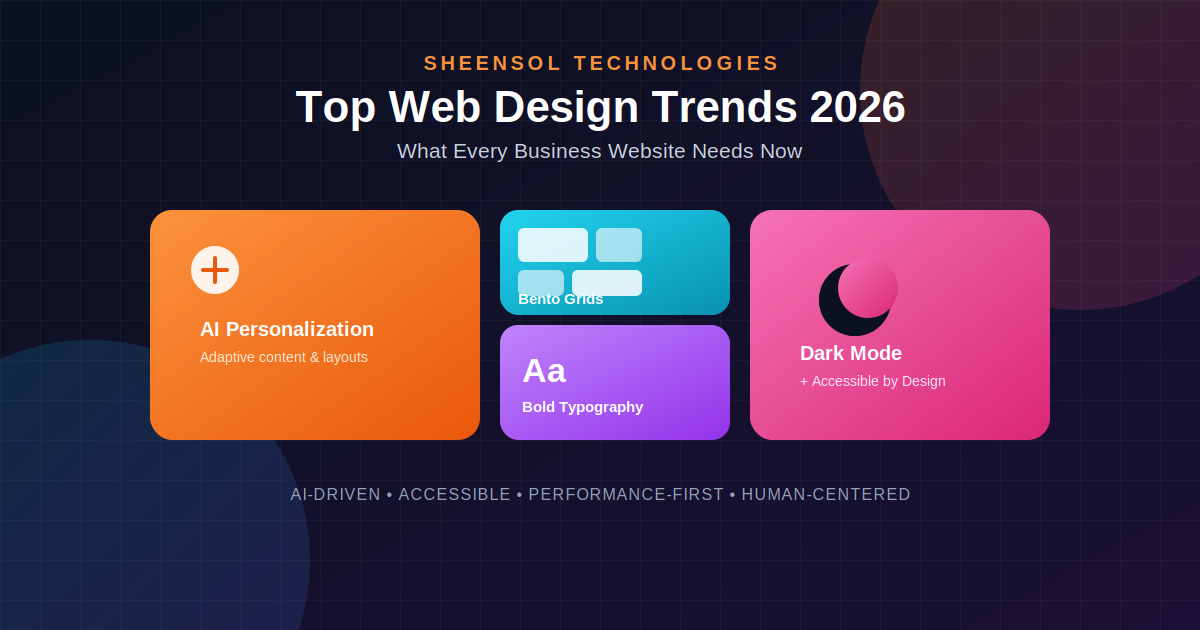
1. AI-Powered Personalization
Static, one-size-fits-all websites are losing ground. In 2026, AI tools allow websites to adapt content, layout, and even product recommendations in real time based on a visitor’s behavior, location, or browsing history. A returning visitor might see different homepage content than a first-time one; an e-commerce shopper might see recommendations tailored to what they’ve already viewed.
Why it matters for your business: Personalized experiences increase engagement and conversion rates because visitors see content that’s actually relevant to them, instead of generic messaging meant for everyone.
2. Bento Grid Layouts
Borrowed from Japanese bento box design, this layout style organizes content into clean, modular, asymmetric grid cells — similar to what you’d see on Apple’s product pages. It’s become one of the most popular ways to present services, features, or portfolio pieces because it’s visually organized without feeling rigid or boring.
Why it matters for your business: Bento grids make dense information easy to scan, which is especially useful for service pages, pricing tables, and feature comparisons.
3. Bold, Expressive Typography
Typography has moved from a supporting player to the main character. Oversized headlines, dynamic thin-thick font pairings, and kinetic (animated) type are being used to communicate a message in seconds — because attention spans are shorter and visitors decide whether to stay within moments of landing.
Why it matters for your business: Strong typography builds brand personality fast and helps key messages land before a visitor scrolls away.
4. Micro-Interactions
Small, thoughtful design details — a button that reacts when tapped, a subtle animation as you scroll, a form field that gently confirms input — are becoming standard rather than optional. These micro-interactions guide users through a site intuitively and make the experience feel polished and responsive.
Why it matters for your business: These details reduce friction and confusion, which directly improves how long visitors stay and how likely they are to complete an action like filling out a form or making a purchase.
5. Dark Mode and Adaptive Color Schemes
Dark mode has moved well past being a niche developer preference. More websites now offer dark and light themes, or default to darker palettes for a sleek, modern feel — particularly in tech, SaaS, and creative industries. Beyond aesthetics, dark interfaces can reduce eye strain and battery usage on mobile devices.
Why it matters for your business: Offering theme flexibility signals a modern, user-first brand and can improve time-on-site, especially for visitors browsing at night.
6. Glassmorphism and Soft 3D Elements
Frosted-glass effects, soft shadows, and subtle three-dimensional elements are back in a more refined form this year. Rather than the flat, minimal design that dominated the last several years, 2026 interfaces are layering translucent panels and gentle depth to make interfaces feel more tactile and realistic.
Why it matters for your business: These effects add visual sophistication without sacrificing the clean, fast-loading experience users expect.
7. Accessibility-First Design
Accessibility is no longer an afterthought bolted on before launch — it’s being built into design decisions from day one. That means sufficient color contrast, keyboard navigability, screen-reader-friendly structure, and inclusive imagery are considered from the very first wireframe.
Why it matters for your business: Beyond being the right thing to do, accessible design expands your addressable audience, reduces legal risk, and is increasingly factored into how search engines evaluate site quality.
8. Voice Search and Conversational Interfaces
As voice assistants and conversational AI become part of everyday browsing, websites are being restructured to answer questions directly and conversationally, rather than relying purely on keyword-stuffed pages. Expect more FAQ-style content, structured data, and chat-based interfaces that let visitors “ask” a website what they need.
Why it matters for your business: Optimizing for conversational and voice queries positions your site to capture traffic from AI-powered search experiences, not just traditional Google results.
9. Sustainable, Performance-First Web Design
Fast-loading, lightweight websites aren’t just a nice-to-have — they’re increasingly framed as a sustainability issue, since heavier websites consume more energy to load and serve. Designers in 2026 are prioritizing optimized images, minimal code bloat, and efficient hosting as part of a broader “green web design” movement.
Why it matters for your business: Faster sites rank better in search, convert more visitors, and cost less to host — sustainability and performance go hand in hand here.
10. The “TL;DR” Content Experience
With attention spans shrinking and information overload at an all-time high, more websites are offering structured, scannable overviews — summaries, key takeaways, and collapsible sections — that let visitors choose how deep they want to go. Instead of forcing everyone through a wall of text, sites are respecting that some visitors want the two-line version and others want the full deep dive.
Why it matters for your business: This structure keeps both quick browsers and serious researchers engaged, instead of losing one group to frustration.
What This Means for Your Website in 2026
You don’t need to chase every trend on this list. What matters is identifying which of these genuinely serve your visitors and your business goals. A few practical starting points:
- Audit your current site’s speed and mobile experience — performance still underpins every other trend on this list.
- Review your typography and visual hierarchy — is your key message clear within 3 seconds of landing?
- Check your accessibility basics — color contrast, alt text, and keyboard navigation are quick wins with real impact.
- Consider where personalization or AI-driven content could genuinely improve the experience — not just for the sake of using AI.
- Look at your content structure — could key pages benefit from a scannable, TL;DR-style layout?
The best-performing websites in 2026 aren’t the flashiest ones — they’re the ones that pair bold, human-centered design with genuine speed, clarity, and usability.
Let SheenSol Bring Your Website Into 2026
Whether your site needs a full redesign or a strategic refresh, our team at SheenSol Technologies can help you apply the trends that matter most for your industry and audience — without losing sight of performance, accessibility, and conversions.
Get a free quote to discuss your website redesign, or explore our website design services to see how we can help.
Recommended Posts
Progressive Web Apps (PWAs) vs Native Apps: What is Best for Your Business in 2026?
September 8, 2026

Magento vs Shopify
January 19, 2017