



by imran
Progressive Web Apps (PWAs) vs Native Apps: What’s Best for Your Business in 2026?
If you’re planning to invest in a mobile presence for your business, you’ll eventually run into this question: should you build a Progressive Web App (PWA) or a native mobile app? It’s one of the most common decisions businesses face today, and getting it wrong can mean wasted budget, missed deadlines, or a product that doesn’t actually serve your customers well.
At SheenSol Technologies, we get asked this almost every week by clients planning their mobile strategy. In this guide, we’ll break down exactly what PWAs and native apps are, how they compare on the things that actually matter to your business — cost, speed, performance, and reach — and help you figure out which one (or which combination) makes sense for you in 2026.
What Is a Progressive Web App (PWA)?
A Progressive Web App is a website built with standard web technologies (HTML, CSS, and JavaScript) that behaves like a mobile app. Users can visit it in a browser, then “install” it directly to their home screen — no app store download required. Once installed, a PWA can work offline, send push notifications, and load almost instantly, all while living inside a single codebase that runs on any device.
Three technical pieces make this possible:
- Service workers – background scripts that cache content and enable offline access
- Web app manifests – configuration files that control how the app looks and behaves once installed
- HTTPS delivery – secure connections required for the advanced features above to work
In short, a PWA gives you most of the convenience of an app with the reach and flexibility of a website.
What Is a Native App?
A native app is built specifically for one operating system — Swift or Objective-C for iOS, Kotlin or Java for Android — and distributed through the Apple App Store or Google Play Store. Because it’s built directly for the platform, it has full access to device hardware: camera, GPS, biometric sensors, Bluetooth, background processing, and more. This typically results in smoother performance and a more polished user experience, but it comes at a higher cost, since you’re often building and maintaining two separate codebases (one for iOS, one for Android).
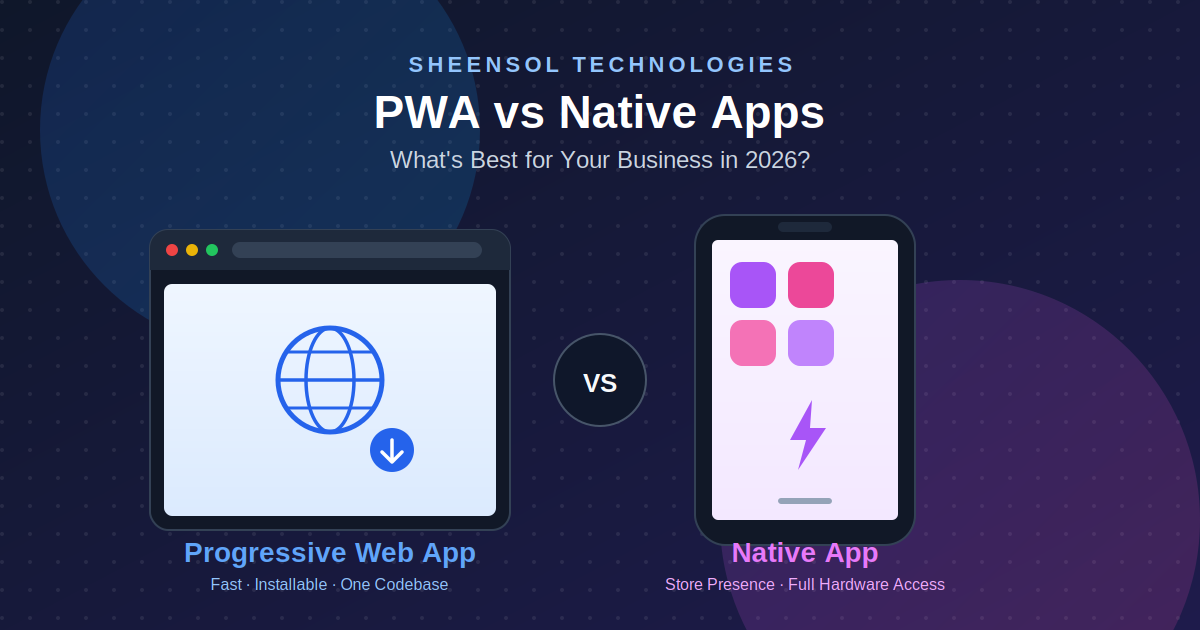 PWA vs Native App: Head-to-Head Comparison
| Factor | Progressive Web App (PWA) | Native App |
|---|---|---|
| Development cost | Lower — one codebase for all platforms | Higher — separate builds for iOS and Android |
| Time to market | Faster, often weeks instead of months | Slower due to platform-specific development and app store review |
| Distribution | Shareable via a link; installable from the browser | Must be downloaded from an app store |
| App store presence | Not listed (unless separately packaged) | Listed on App Store / Google Play, aiding discoverability |
| Performance | Very good for most use cases; can lag for graphics-heavy apps | Best possible performance, especially for games and complex apps |
| Offline functionality | Available, but more limited | Full offline capability |
| Push notifications | Supported on Android; limited/newer support on iOS | Fully supported on both platforms |
| Device hardware access | Improving, but still restricted compared to native | Full access to camera, sensors, Bluetooth, NFC, etc. |
| Updates | Instant — updates the moment you publish, no user action needed | Requires user to download updates, and app store approval first |
| SEO & discoverability | Fully indexable by Google, so it can drive organic traffic | Not indexed by search engines |
| Maintenance | One codebase to maintain | Two (or more) codebases to maintain |
Why This Decision Matters More in 2026
A few shifts happening right now make this comparison especially relevant:
App fatigue is real. Most smartphone users are reluctant to download a new app just to browse a business, check a menu, or book a service. Every extra step between “interested” and “using your product” costs you conversions. A PWA removes the download barrier entirely.
AI-assisted development has changed the cost equation. Both PWA and native development have gotten faster and cheaper thanks to AI-powered tools and no-code/low-code platforms, but PWAs still tend to reach the market meaningfully faster and at a lower cost than a fully native build, since there’s only one codebase to design, build, and test.
Search visibility increasingly matters for mobile experiences. Since native apps live inside app stores and aren’t crawled by Google, all of that app-based engagement is invisible to search engines. A PWA, on the other hand, is just a website — meaning every page can be indexed, ranked, and found organically, extending the value of your SEO investment.
iOS has been steadily closing the gap. Apple has historically limited what PWAs can do on iPhones (notifications, install prompts, offline storage), but each iOS update has chipped away at those restrictions. PWAs are more capable on Apple devices today than they were even two years ago.
When a PWA Is the Better Choice
A PWA tends to be the right call when:
- You want to launch quickly and validate an idea without a large upfront investment
- Your core need is broad reach across devices (mobile, tablet, desktop) from one build
- Organic search traffic is an important part of your growth strategy
- Your app’s functionality is largely content-, booking-, or service-based (restaurants, real estate, retail, service businesses, news, e-commerce)
- You want to reduce long-term maintenance overhead
When a Native App Is the Better Choice
A native app makes more sense when:
- Your product depends on deep hardware integration — camera-based features, AR, fitness/health sensors, Bluetooth-connected devices
- Performance is mission-critical, such as in gaming, video editing, or real-time processing apps
- You need robust, guaranteed offline functionality beyond basic caching
- Being featured in the App Store or Google Play is part of your marketing and credibility strategy
- Your users expect (and will pay for) a premium, platform-native experience
The Hybrid Approach: Why Many Businesses Choose Both
For many growing businesses, the real answer isn’t “PWA or native” — it’s “PWA first, native later.” A common and cost-effective growth path looks like this:
- Launch a PWA to test the market, gather user feedback, and start ranking in search results with minimal investment.
- Grow your engaged user base through the PWA’s speed, shareability, and SEO advantages.
- Build a native app once you’ve validated demand and identified the customers who’ll benefit from a deeper, app-store-based relationship — power users who want push notifications, offline access, and hardware features.
This staged approach lets you avoid spending a large native development budget before you know your app will resonate with users.
Our Recommendation
For most small and mid-sized businesses — retailers, service providers, restaurants, real estate agencies, and B2B companies — a PWA is the smarter starting point in 2026. It’s faster to launch, less expensive to maintain, and it works in harmony with your website and SEO strategy rather than existing in a separate silo.
If your business model genuinely depends on deep device integration, top-tier performance, or a strong app store presence (think fitness apps, games, or fintech products handling sensitive on-device data), native development is worth the extra investment.
And if you’re not sure which category you fall into, that’s a conversation worth having before you commit budget either way.
Ready to Build Your Mobile Strategy?
At SheenSol Technologies, we help businesses design and develop both Progressive Web Apps and native mobile applications, tailored to what your business actually needs — not just what’s trending. Whether you’re looking to launch fast with a PWA or invest in a full native experience, our team can walk you through the right approach for your goals and budget.
Get in touch with our team to discuss your project, or explore our mobile development services to learn more.
Recommended Posts

Top Web Design Trends 2026: What Your Business Site Needs
September 8, 2026


Magento vs Shopify
January 19, 2017